

DynoAgent
A conversational analyst with read access to your store's data and gated write access — every change is previewed, approved, logged and revertible.
DynoAgent is the difference between a dashboard and an answer. A dashboard makes you know where the number lives before you can ask for it. DynoAgent takes the question.
It has read access to everything DynoWeb tracks — clicks, scrolls, frustration signals, journeys, conversions, traffic sources, performance — plus your Shopify catalogue. And it can write: rewrite a product description, create a discount, generate an image, publish a page. Every write goes through an approval gate first.
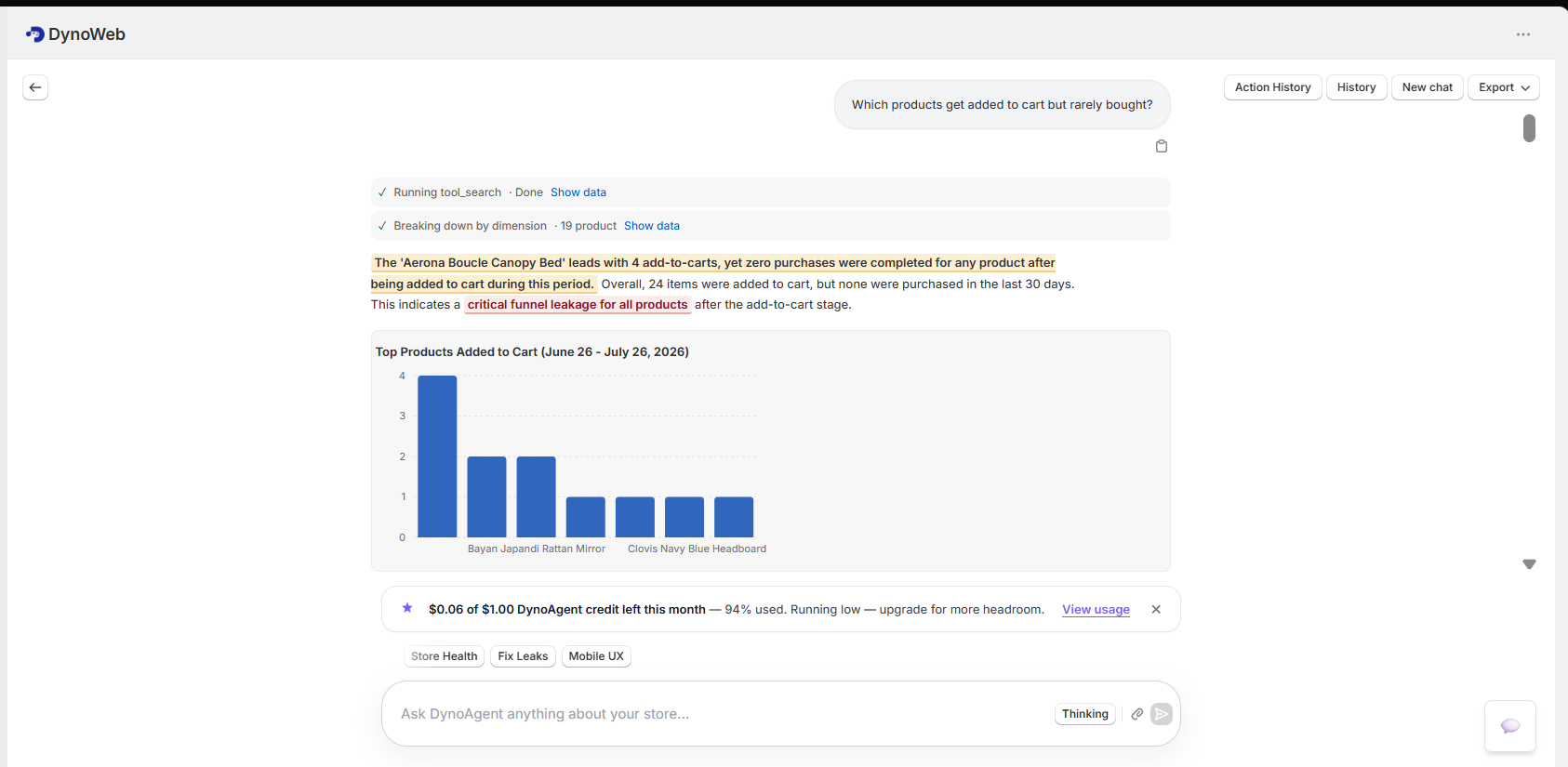
Asking about your store
Roughly two dozen analysis tools sit behind the chat, and the agent picks and composes them. So questions can be shaped how you actually think, not how a report is filed:
- "Which products have the most traffic and the lowest conversion?"
- "Where are visitors rage-clicking most this week?"
- "Compare this week's conversion rate to last week."
- "What's my best-selling product with the worst UX signals?"
- "Give me a quick health check of my store."
- "Which traffic source actually makes money?"
The last two are composite — a health check spans engagement, frustration, conversion and performance; the traffic question joins channel data to attributed revenue. Composing those is the point of the agent, because they are the questions a dashboard cannot have a page for.
The tool surface also covers cohort comparison, funnel queries, scroll and form analytics, element-level metrics, trend and pattern analysis, period comparison, segment session lookup, storefront error queries, churn-risk and pricing analysis, campaign planning, and an insight memory that lets it recall what you established in an earlier conversation.
Making changes
You ask for something
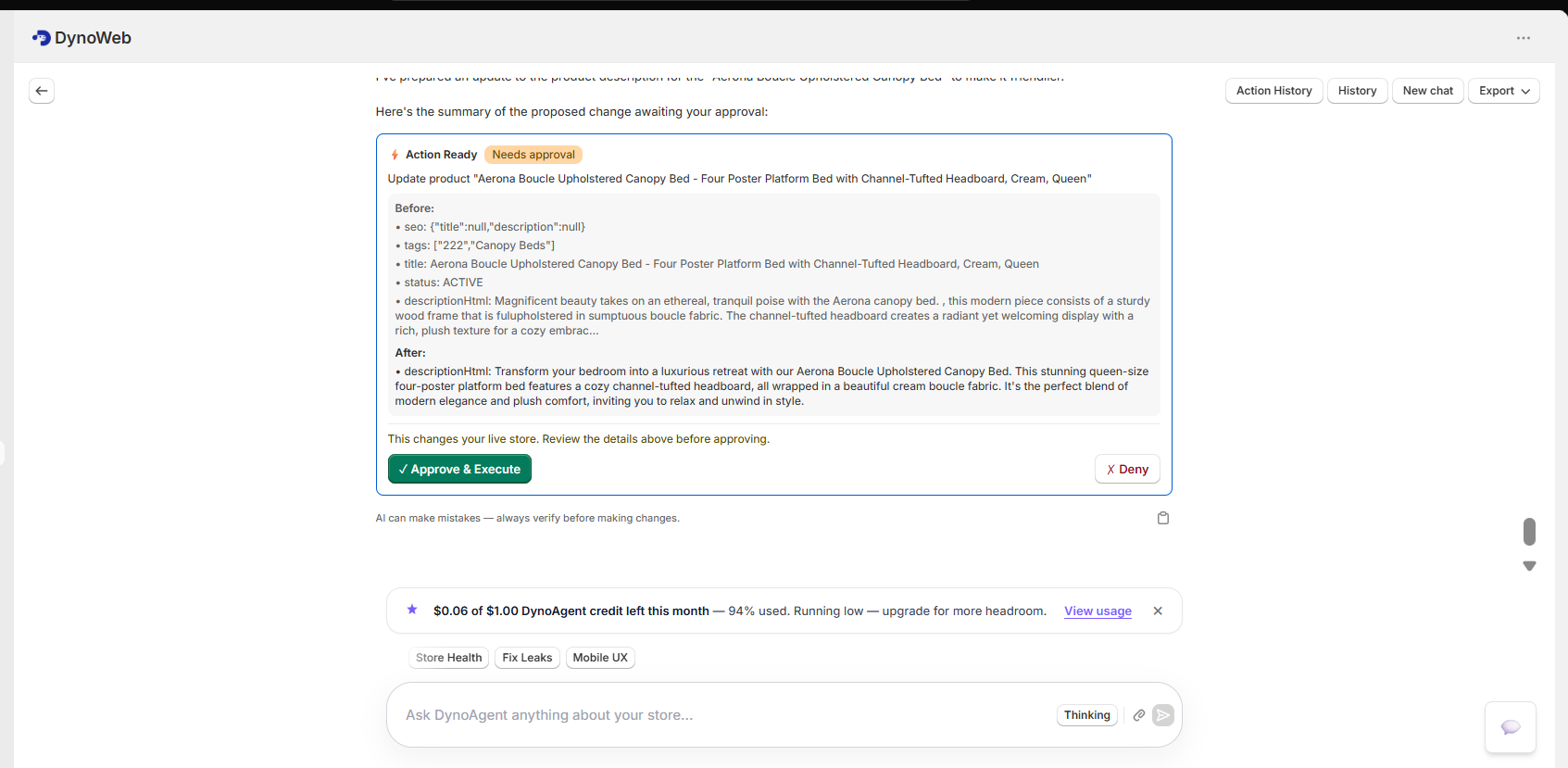
"Rewrite the description for my four worst-converting products, benefit-first."
It drafts, using your data and your voice
Not generic AI copy. The rewrite is informed by what shoppers actually do on that page — what they click, where they stop, what they seem to be looking for — and written in your store's voice as captured by Brand DNA.
You see the exact change first
The proposed before → after is shown in the conversation. Nothing has touched your store yet.
You approve or deny
Per change. Nothing is written until you say so.
It is logged, and revertible
Every executed action lands in the action history with before-and-after snapshots, and any one of them can be undone in a click, restoring the prior value.
The approval gate is not a setting
There is no autonomous mode to switch on. Writes are queued as pending actions and executed only after you approve them, by design. An agent with unsupervised write access to a live storefront is a bad idea regardless of how good the model is.
What it can write
| Area | Capability |
|---|---|
| Products | Descriptions, SEO title and meta description, variant prices, bulk updates across a collection |
| Collections | Titles and descriptions |
| Pages | Create and update — About, FAQ, policy pages, landing copy |
| Blog | Create and update articles across your blogs |
| Discounts | Create codes, including ones tied to a Popups |
| Images | Generate product lifestyle shots and marketing banners, previewed in chat before anything is added |
| Popups | Create, update, preview, publish and A/B test interventions end to end |
Bulk operations are batched — "rewrite every description in the Summer collection" is one instruction, not forty — and are a Custom-plan capability.
Searching outside your store
DynoAgent can search the web in the same conversation as your store data, so competitive and keyword questions do not require a second tab:
- "What are competitors charging for something like this?"
- "What keywords are trending for this product type?"
The value is the join: external context and your own conversion data in one answer.
Usage and cost
Actions are metered, and the meter is tiered by what an action costs to run:
- Reads — most analysis queries — are the cheap tier
- Writes — anything that mutates your store — cost more
- Model-heavy work — long generation, deep reasoning — draws on a separate monthly AI budget rather than the action count
Daily action allowances: 500 on Free, 1,500 on Pro, 5,000 on Custom. Free and Growth carry a $1/month AI budget; Growth and Pro can add more as a paid add-on (+$5 and +$10 respectively), and Custom includes a $40 monthly credit. Free is limited to basic queries; writes need a paid plan.
Conversations export as Markdown or CSV.
Limits
- It answers from your tracked data, so it inherits that data's gaps. If a page has little traffic, the agent will say so rather than invent a trend — but a confident-sounding answer about a thin dataset is still thin.
- Generated copy is a draft. It is grounded in behaviour and voice, which makes it a good draft. It is not a substitute for reading it before approving it, particularly on claims, sizing, materials and anything regulated.
- Web search returns what is published, not what is true. Competitor pricing found this way is a snapshot of a public page.
- Revert restores DynoWeb's recorded prior value. If something else changed the same field in between — you, another app, a theme update — reverting sets it back to what DynoWeb captured, which may not be the newest value.
- It is not a scheduler. DynoAgent acts within a conversation. Recurring automation lives in the cron-driven features (SEO Autopilot, Impact, performance audits), not here.
Related
CRO Report
The full-store audit the agent can read from, costed and ranked.
MCP Integration
The same tool surface, driven from Claude, Cursor or any MCP client instead of the in-app chat.
AI Suggestions
The ranked queue version of the same analysis, for when you'd rather read than ask.
Common questions
Can DynoAgent change my products or theme on its own?
No. It can draft and stage changes, but every write to your Shopify store requires your explicit approval. There is no autonomous mode that edits your storefront in the background.
What data does it have access to?
Your DynoWeb behavioral data plus the Shopify scopes you granted at install — products, collections, orders, themes and pages. It does not reach outside your store.
Is my store data used to train models?
Your store data is used to answer your questions and generate your suggestions. It is not pooled into training data for other merchants.
Can I use it from my own editor instead?
Yes. MCP Integration exposes the same store context to Claude, Cursor and ChatGPT, so developers can work against the data without opening the dashboard.
AI Suggestions
Three analysis layers turn behavioural data into a ranked queue of fixes, each scored on five axes with the evidence attached — plus the full CRO Report audit.
CRO Report
A full-store conversion audit that costs the leak from six pure-math formulas, ranks the fixes, and states its confidence — or refuses to give a number at all.